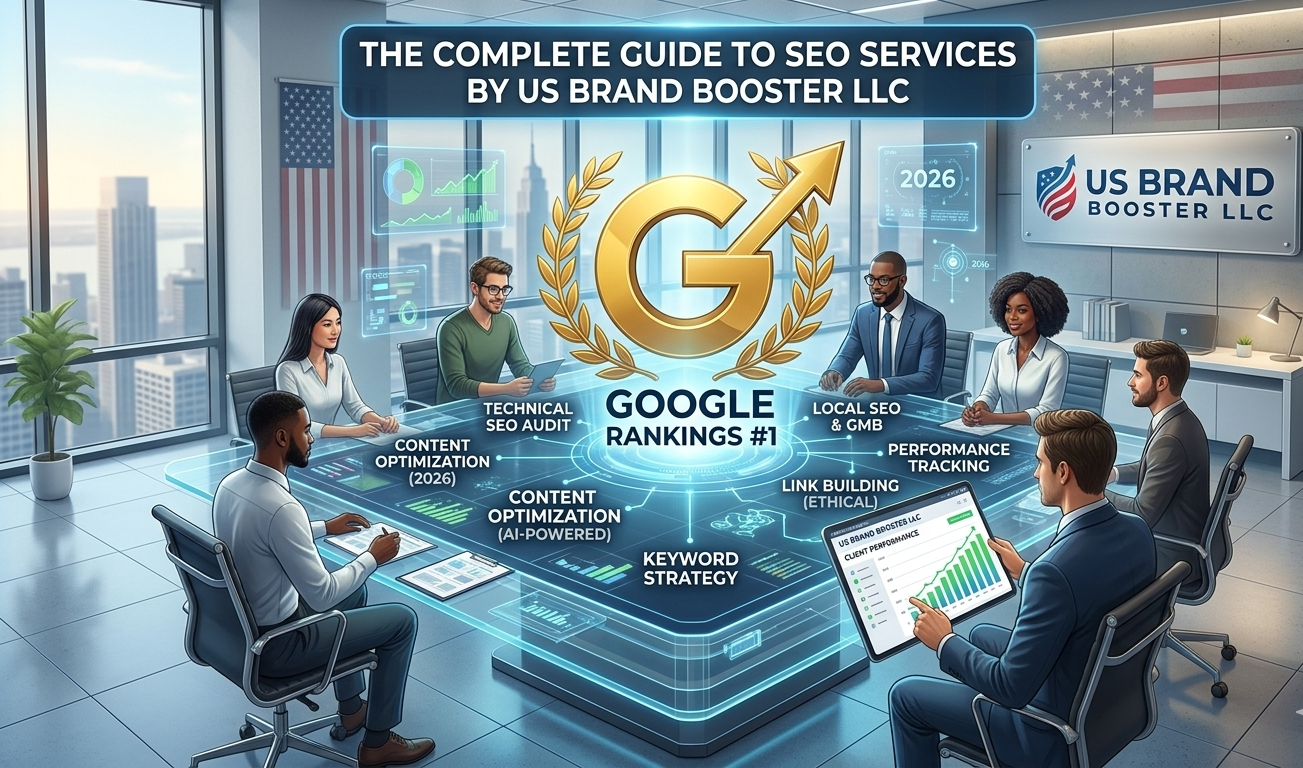

In 2026, the SEO landscape is no longer just a race for the “blue link.” With the explosion of AI Overviews and Search Generative Experience (SGE), the focus has shifted from simple keyword matching to Generative Engine Optimization (GEO).
Below is a complete, step-by-step strategy developed by US Brand Booster LLC to ensure your brand doesn’t just rank, but becomes the cited authority that AI engines recommend.
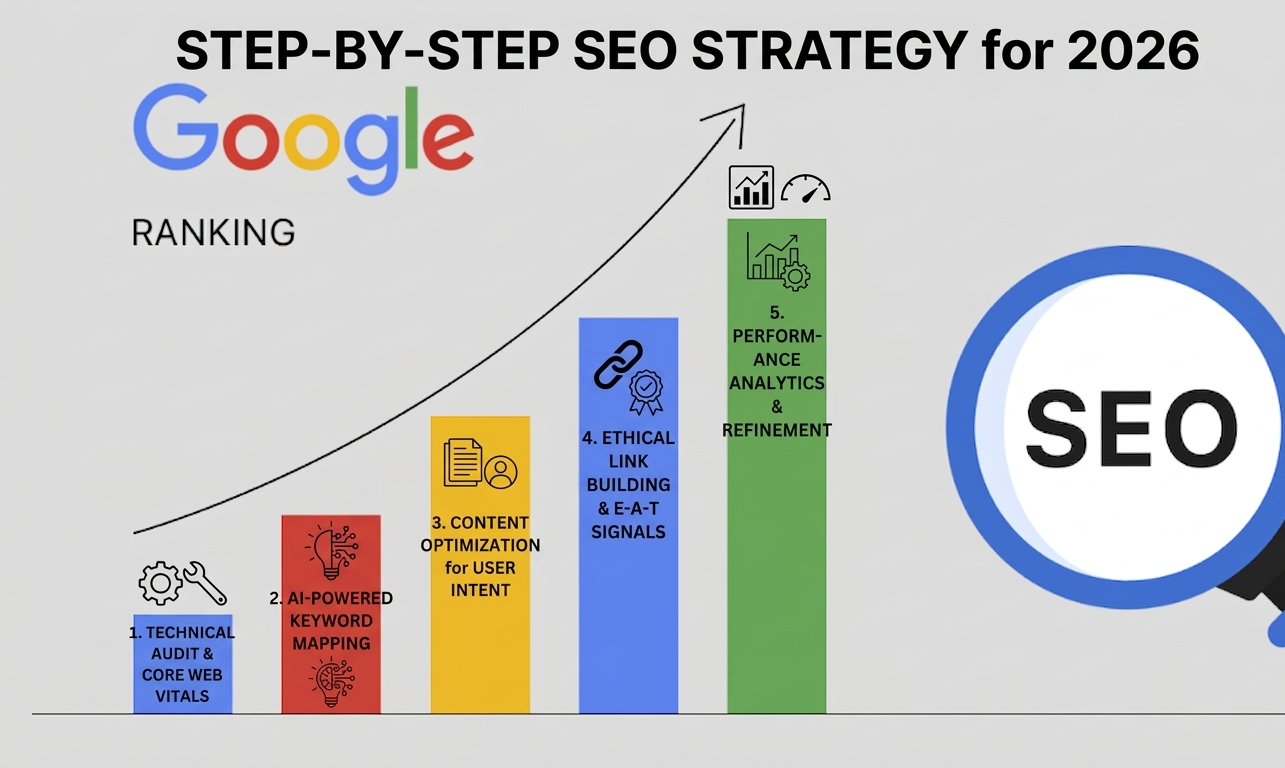
Step-by-Step SEO Strategy for 2026
Mastering SEO in 2026 requires a “Generative-First” approach. Start by securing Topical Authority through deep-dive content clusters. Next, optimize for AI Overviews by providing concise, data-backed answers. Finally, prioritize User Intent Signals and technical performance to ensure your brand remains the top-cited source in an AI-driven search landscape.
Optimize for the “Zero-Click” Reality
In 2026, over 60% of searches conclude without a single click as AI Overviews provide immediate solutions. To thrive, your strategy must pivot from driving clicks to winning citations. By structuring data for generative engines, you ensure your brand becomes the definitive source AI models present to users, maintaining high-value visibility and authority even when traditional web traffic patterns shift.
The “Direct-Answer” Hook
Capturing a featured snippet or AI citation requires the “Direct-Answer” Hook. This technique involves placing a clear, 40-word summary at the beginning of your content to satisfy immediate user intent. By front-loading the “what” and “how,” you signal relevance to search crawlers, making your prose the primary candidate for AI-generated summaries and voice search responses in 2026.
Fact Density
Search engines now equate quality with “Fact Density.” To rank in an AI-dominated era, move beyond fluff and generalities. Integrate specific statistics, proprietary data, and verified expert insights into every paragraph. High fact density proves your expertise to LLMs, ensuring your content is treated as a reliable knowledge base rather than a generic summary, which is vital for E-E-A-T.
Transition from Keywords to “Entities”
In 2026, search engines prioritize entities—the relationships between brands, people, and concepts—over simple keywords. Move beyond literal text matching by defining your brand as a distinct entity within your niche. By connecting your content to established industry nodes, you help AI understand exactly who you are and what you represent, ensuring your brand appears in relevant, intent-based conversational queries.
Topical Authority
Establishing Topical Authority is the cornerstone of 2026 SEO. Rather than chasing disparate keywords, build comprehensive content clusters that answer every conceivable question within your specialized field. By demonstrating deep, interconnected knowledge, you signal to search engines that your site is the definitive expert. This holistic approach ensures your brand is the primary recommendation for both users and generative AI models.
Knowledge Graph Integration
To dominate modern search, your brand must exist within the global Knowledge Graph. By using precise Schema markup and securing mentions on authoritative, third-party platforms, you provide search engines with a clear map of your brand’s credentials. This technical integration ensures AI agents can instantly verify your expertise, leading to higher trust scores and more frequent citations in AI-generated search summaries.
Implement Advanced Schema & Structured Data
In 2026, Schema markup is the primary language of search. By providing search engines with explicit, structured data, you remove the guesswork for AI crawlers trying to interpret your content. Advanced implementation ensures your brand’s key details—like pricing, reviews, and professional credentials—are accurately pulled into interactive search rich snippets and AI-generated comparison tables.
Author Schema
Establishing E-E-A-T starts with the “Person” schema. By 2026, Google prioritizes content verified by real experts. By linking an author’s professional history, social profiles, and past publications directly within your code, you prove to AI engines that your information comes from a credible, human source. This transparency is a critical ranking factor for health, finance, and technical niches.
Product & FAQ Schema
Maximize your real estate on the SERP (Search Engine Results Page) using Product and FAQ Schema. These tags allow AI agents to pull real-time data, such as stock availability or direct answers to common customer hurdles, directly into the search interface. This high-level technical optimization reduces friction for the user and positions your brand as the most accessible solution in your industry.
Master Multimodal SEO
In 2026, search is no longer a text-only experience. Users are increasingly searching with their cameras via Google Lens or using Voice Search while on the go. To stay visible, your content must be technically fluid across all formats, ensuring that images, videos, and audio are as discoverable as your written blog posts.
Video Context & Transcripts
AI engines like Gemini and Search Generative Experience (SGE) now “watch” videos to find answers. To optimize for this, US Brand Booster LLC recommends including full, keyword-rich transcripts and using Video Chapters. By labeling specific segments (e.g., “Step 1: Technical Audit”), you allow AI to clip and surface your video as a direct answer for complex “how-to” queries.
Image Optimization for Visual Intent
Visual search has evolved beyond basic Alt Text. In 2026, AI evaluates “Visual Signatures”—the context, objects, and text within your images. Use high-resolution, original photography with descriptive file names and ImageObject Schema. This ensures your brand appears in “Shop the Look” results or visual research panels when users snap a photo of a product or a competitor’s storefront.
Prioritize “Freshness” and Technical Accessibility
In 2026, search engines exhibit a strong “recency bias,” prioritizing content that reflects current market conditions. US Brand Booster LLC emphasizes that “freshness” isn’t just about the publication date—it’s about data accuracy. Ensuring your technical infrastructure allows AI bots to crawl and index this new data instantly is the difference between leading the market and fading into obsolescence.
Regular Content Audits
Static content is dead weight. To maintain high rankings, implement a rolling audit cycle where cornerstone articles are updated every six months. Replace outdated statistics, refresh “current year” mentions, and verify that all outbound links still point to authoritative sources. This constant refinement signals to AI engines that your brand is a live, active expert in your field.
AI Crawler Access
Technical SEO in 2026 requires managing “Bot Rights.” Review your robots.txt file to ensure you aren’t inadvertently blocking critical agents like GPTBot, CCBot, or Google-InspectionTool. If AI models cannot access your site’s high-quality data, they cannot cite you in their answers. Strategic accessibility ensures your brand remains the primary knowledge source for generative search engines.
Conclusion
The SEO landscape of 2026 demands a shift from chasing algorithms to commanding authority. By prioritizing Generative Engine Optimization (GEO) and technical accessibility, your brand ensures it remains the definitive answer in an AI-driven world. Success now lies in being the most trusted, cited, and data-rich entity in your niche. Partner with US Brand Booster LLC to navigate these complexities, future-proof your digital presence, and turn search evolution into your greatest competitive advantage. The future of search is here—let’s lead it.