
For over two decades, the goal of SEO was straightforward: win the first page of Google. If you captured that coveted position-one spot, the organic traffic naturally followed.
But as we cross midway into 2026, the search bar has radically transformed. Traditional position-one organic click-through rates (CTR) have plummeted by up to 60% whenever an AI Overview is present. Discovery is no longer driven by a list of ranked blue links; it is driven by synthesized answers.
To future-proof your digital presence, you need to transition your mindset from traditional SEO to GEO (Generative Engine Optimization). Your goal is no longer just ranking on page one—it is being cited as the authoritative answer by ChatGPT Search, Perplexity, Claude, and Google Gemini.
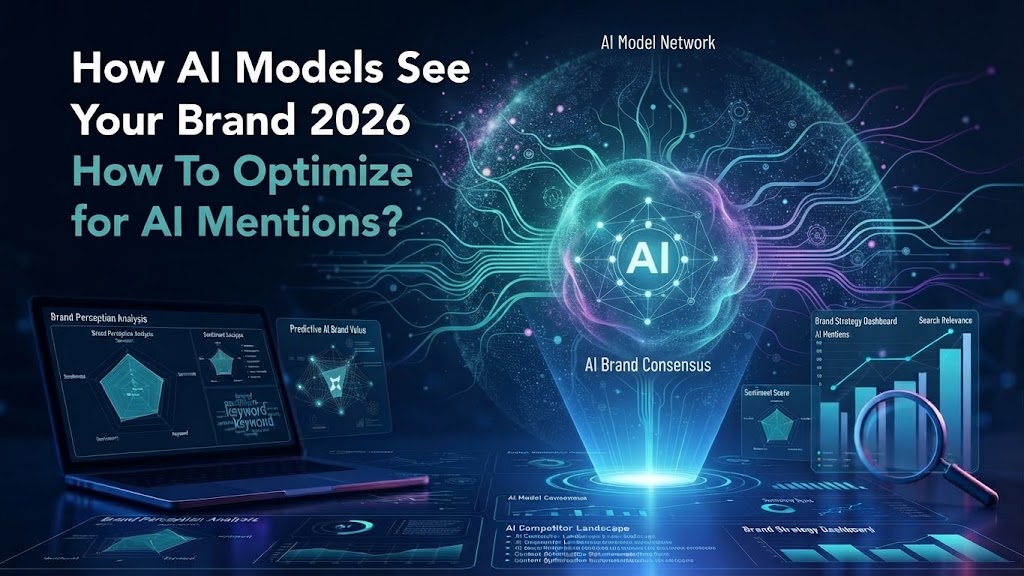
Here is exactly how AI models see your brand right now, and how to optimize your content so they actively recommend you.
The AI Perception Gap: How LLMs Actually “See” You
Large Language Models (LLMs) do not browse your website the way a human user does, nor do they score it strictly on the legacy backlink math of traditional search engines. AI models perceive your brand through three core pillars:
Extractability
AI models prioritize structure and speed. They don’t read text like humans; they crawl code looking for data blocks they can quickly parse and replicate. If your content is buried in complex layouts, heavy JavaScript, or vague storytelling, a bot will skip it to save compute power. To maximize your extractability, use concise headings, list formatting, and clear summary paragraphs. Making your text highly scannable ensures LLMs can seamlessly cite your data.
Contextual Clarity
To avoid hallucinations, modern AI models crave clarity over cleverness. They favor content that explicitly links concepts together, eliminating ambiguity around your brand’s offerings. If your writing relies on industry buzzwords or abstract metaphors, AI crawlers will struggle to accurately classify what you sell or do. By using exact terminology, defining your niche directly, and providing explicit contextual signals, you ensure the AI accurately understands and confidently recommends your brand.
The Web Ecosystem
AI models evaluate your brand by looking at the entire internet, not just your website. They cross-reference your content with independent mentions on digital forums, industry publications, review platforms, and social hubs like Reddit. This means your reputation off-site heavily dictates how an AI views you. Building a healthy digital ecosystem through community engagement, user reviews, and PR ensures that when an AI scans the web, it finds consistent, authoritative praise.

Traditional SEO vs. Generative Engine Optimization (GEO)
To understand how to optimize, it helps to understand how the core metrics have shifted.
Feature |
Legacy SEO |
Generative Engine Optimization (GEO) |
| Primary Goal | Drive clicks via keyword positioning. | Earn citations and accurate brand recommendations. |
| Search Intent | 2-3 word static keywords. | Conversational, long-tail multi-turn prompts. |
| Content Focus | Long-form, comprehensive text. | Factual, data-dense, “snippable” content blocks. |
| Core Metric | Clicks, impressions, and organic sessions. | Share of Model (SoM) and citation frequency. |
Your 4-Step Checklist to Optimize for AI Mentions
If you want AI bots to dig into your site and reference your brand over your competitors, implement this 4-step framework today.
-
Build a Technical “Open Door” Policy
Before any AI model can recommend your brand, its crawler must be able to read your website cleanly. Many Content Delivery Networks (CDNs) and firewalls automatically block scraper bots by default to mitigate traffic spikes. You must audit your server settings and update your robots.txt file to explicitly allow verified user-agents like ChatGPT-User, ClaudeBot, and Google-Extended. Furthermore, avoid client-side JavaScript rendering for your most critical data, such as pricing tables or product specifications. If the raw text isn’t present in the initial HTML payload, the AI crawler will miss it entirely, leaving your brand invisible.
-
Format for “Extractability” (The 5-Second Rule)
AI engines prioritize structural transparency because it reduces the computing power required to summarize a page. To pass the “5-Second Rule,” you must structure your content so a bot can instantly extract the core takeaways. Lead every major heading with an “Atomic Answer”—a direct, factual statement of forty to sixty words—before expanding into broader context. Use explicit linguistic markers such as “The key takeaway is” or “Our data shows” to guide the retrieval systems. Replacing marketing fluff with bulleted lists and high fact-density naturally aligns your writing with the formatting that LLMs prefer to cite.
-
Maximize Your Structured Data (JSON-LD)
Schema markup acts as a digital nutrition label, stripping away your website’s visual design to hand-feed raw, organized data to search engines and AI models alike. Deep implementation of JSON-LD is the single most effective technical optimization tool at your disposal. By deploying precise Organization, Product, and FAQ schema, you explicitly define the relationships between your brand name, your offers, and user reviews. This eliminates semantic ambiguity, allowing AI models to easily pull your pricing, availability, and specific feature sets directly into conversational search results when users demand a side-by-side product comparison.
-
Build Authority Outside Your Domain
Because large language models form their conclusions by scanning the entire web ecosystem, off-site digital PR is your ultimate competitive advantage. AI engines rely heavily on community sentiment from platforms like Reddit, Quora, and specialized third-party review sites to verify if a business is trustworthy. If your brand is only praised on your own domain, an AI will view it with skepticism. To optimize your external footprint, identify the specific industry blogs and forums that platforms like Perplexity are already citing as references. Actively pursue features, interviews, and community discussions there to build high-authority, unlinked brand mentions.
Final Thoughts
The era of traditional SEO isn’t dead, but its rules have fundamentally changed. Surviving the search shift requires shifting your strategy from ranking for clicks to optimizing for AI comprehension. By prioritizing data density, technical extractability, and building a trusted reputation across the broader web ecosystem, you ensure your company isn’t left behind. Stop trying to beat the algorithm—start formatting your brand to be the definitive answer.