
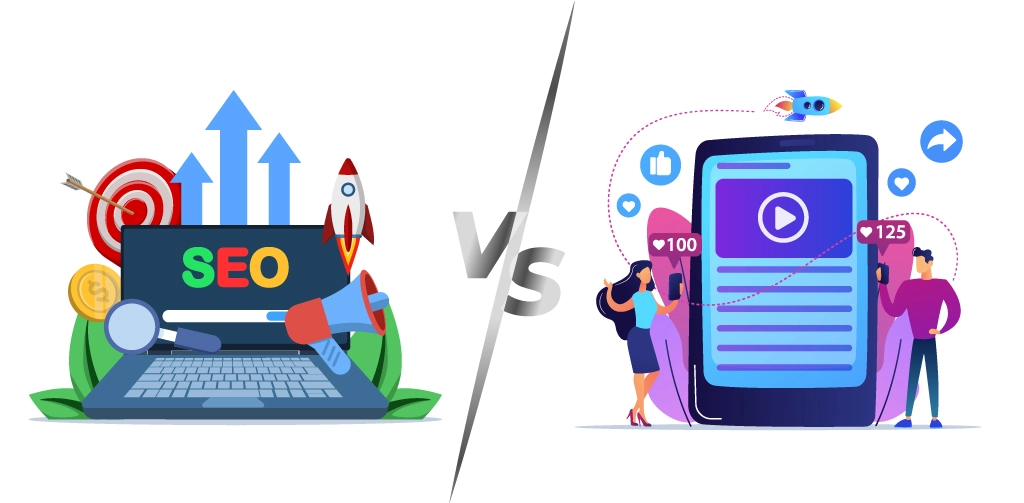
In the rapidly evolving digital landscape of 2026, the debate between Search Engine Optimization (SEO) and (SMM) Social Media Marketing has shifted. It’s no longer just about Google vs. Facebook; it’s about Intent vs. Discovery.
If you have a limited budget or a new brand, you’re likely asking: Where should I put my next dollar? This guide breaks down the strengths, weaknesses, and ROI of both strategies to help you decide which is better for your specific business goals.
At a Glance: The Core Difference
Feature |
SEO (Search Engine Optimization) |
Social Media Marketing |
| Primary Goal | Capturing existing demand (Intent) | Generating new demand (Discovery) |
| Speed of Results | Slow (3–6+ months) | Fast (Instant with ads) |
| Content Lifespan | Long (Years/Evergreen) | Short (Hours/Days) |
| User Mindset | Problem-solving / Ready to buy | Bored / Seeking entertainment |
| Long-term Cost | Decreasing cost per lead | Ongoing investment required |
The Case for SEO: Building Your Digital Real Estate
Investing in SEO is like acquiring prime digital real estate. Unlike social media’s “rented” space, SEO allows you to build a permanent asset that generates compounding value. By optimizing for high-intent search queries, you capture users actively seeking solutions, leading to higher conversion rates. Once your content ranks, it provides a sustainable stream of organic traffic without recurring ad costs, establishing long-term authority and trust in an increasingly crowded marketplace.
Why SEO Wins in 2026?
In 2026, the digital landscape has shifted toward AI-driven answers and highly personalized results, yet SEO remains the most reliable foundation for digital growth. As platforms become more fragmented, search engines have evolved into sophisticated “trust engines” that prioritize depth and accuracy. SEO wins this year because it transcends simple keyword matching, focusing instead on user intent and technical excellence to ensure your brand remains visible, credible, and profitable in an increasingly automated world.
High-Intent Traffic Precision
In 2026, search engines have perfected the art of understanding user intent, making SEO the ultimate tool for capturing “ready-to-buy” customers. Unlike social media, where users are often browsing for entertainment, searchers are actively hunting for specific solutions, products, or information. By optimizing for these hyper-specific queries, your business intercepts the customer at the exact moment of need. This precision results in significantly higher conversion rates, as you are solving a problem rather than interrupting a scroll.
Long-Term Asset Compounding
While paid advertising stops the moment your budget runs out, SEO functions as a permanent digital asset that grows in value over time. In 2026, the compounding nature of organic rankings means that a high-quality, authoritative piece of content published today can continue to attract leads for years without additional investment. This sustainability offers a much lower long-term cost-per-acquisition compared to social ads, providing your business with a stable, recession-proof source of traffic that builds massive brand equity.
E-E-A-T and AI Credibility
With the explosion of AI-generated content, users in 2026 are more skeptical than ever, making Google’s E-E-A-T (Experience, Expertise, Authoritativeness, and Trustworthiness) signals vital. SEO wins because it forces businesses to prove their human expertise and real-world authority. By securing top rankings and appearing in AI-generated summaries, you signal to both algorithms and humans that your brand is a verified, trustworthy source. This level of credibility is difficult to replicate through the fleeting, often superficial nature of social media trends.
The Case for Social Media: The Speed of Trust
Social media thrives on the “speed of trust,” offering immediate connection in a way search engines cannot. By leveraging real-time engagement and visual storytelling, brands can build emotional loyalty instantly. In 2026, social platforms serve as powerful discovery engines where authentic human interaction bypasses traditional sales funnels. Whether through influencer collaborations or community dialogue, social media transforms cold prospects into brand advocates overnight, making it the fastest route to visibility.
Why Social Media Wins in 2026?
In 2026, social media has evolved from a simple networking tool into a comprehensive ecosystem where brands are built, challenged, and chosen in real-time. While SEO relies on users finding you, social media allows you to find them. It wins this year by prioritizing human connection over data points, using advanced AI to place the right content in front of the right eyes at the exact moment of discovery. This proactive approach turns passive scrolling into active engagement and measurable business growth.
Power of Social Search and Discovery
By 2026, social platforms like TikTok and Instagram have become the primary search engines for younger generations. Users are no longer just looking for links; they are looking for visual proof, authentic reviews, and “how-to” demonstrations. This shift allows brands to bypass traditional search hurdles by optimizing their captions and video scripts for “Social SEO.” This means your content is discoverable by high-intent users who are looking for inspiration and validation, turning social media into a powerful top-of-funnel discovery engine.
Shortening the Path to Purchase via Social Commerce
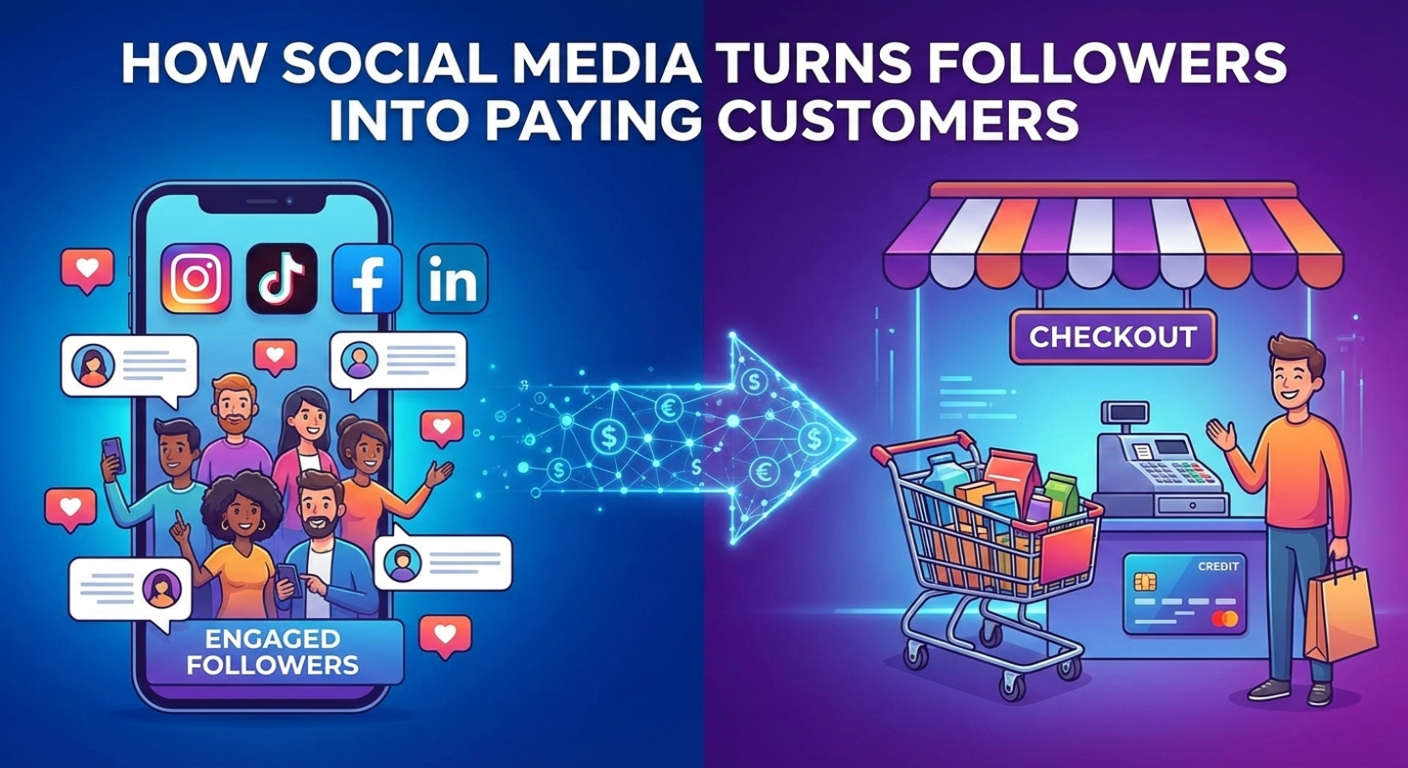
Social media wins in 2026 by collapsing the traditional marketing funnel into a single, seamless experience known as social commerce. With integrated checkout features and shoppable video content, the friction between seeing a product and owning it has virtually disappeared. This immediacy captures impulse purchases and reduces cart abandonment rates significantly. By meeting customers where they already spend their time and allowing them to buy without leaving the app, businesses can drive rapid ROI that traditional website-based funnels struggle to match.
Community Building and Decision Validation
In an era of AI-generated noise, social media serves as a “decision-validation” platform where authenticity is the ultimate currency. Users visit social profiles to confirm a brand’s credibility through real-time interactions, comments, and user-generated content (UGC). Building a dedicated community or a “founder-led” presence creates a level of trust that a static website cannot achieve. This two-way conversation fosters deep brand loyalty and advocacy, ensuring that your business isn’t just a choice in a search result, but a name that customers recognize and trust.
The “70/30 Rule”: Which One Should You Prioritize?
Most successful businesses use a blend of both, but your industry usually dictates where you should focus the bulk of your energy.
- If you sell a NEED (Plumbing, Software, Legal): Spend 70% on SEO. People don’t follow their plumber on Instagram “just for fun”—they search for them when the sink breaks.
- If you sell a WANT (Fashion, Home Decor, Gadgets): Spend 70% on Social Media. These products rely on visual “stop-the-scroll” appeal to trigger an emotional purchase.
The 2026 Secret: The Integrated Approach
In 2026, the most successful brands have stopped viewing marketing as a competition between channels. The “Integrated Approach” is the secret weapon for modern growth, merging the intent of search with the energy of social. By creating a unified digital ecosystem, you ensure that every piece of content works twice as hard. This strategy doesn’t just increase your reach; it creates a seamless journey where a user might discover you on TikTok and eventually convert through a branded Google search.
Cross-Platform Content Repurposing
The most efficient businesses in 2026 use a “create once, distribute everywhere” model to maximize their ROI. An in-depth, SEO-optimized blog post serves as the foundational pillar, which is then sliced into bite-sized LinkedIn insights, engaging video scripts for Reels, and educational Twitter threads. This ensures that your high-value information reaches different audience segments in their preferred formats. By maintaining consistent messaging across both search and social, you reinforce your brand authority and dominate the digital landscape without doubling your workload.
Enhancing SEO Through Social Signals
While Google’s algorithms have always been a closely guarded secret, the correlation between social engagement and search rankings has never been stronger. High-performing social posts drive massive waves of traffic to your website, signaling to search engines that your content is timely, relevant, and valuable. In 2026, “Social SEO” plays a dual role; using keywords in your social captions helps you rank within app search bars, while the resulting brand mentions and shares build the external “buzz” necessary to climb the traditional search engine results pages.
Mapping the Omni-Channel Customer Journey
Modern consumers rarely follow a linear path to purchase; they often bounce between platforms before making a final decision. The integrated approach tracks these touchpoints, using social media to build awareness and SEO to capture the final, high-intent conversion. For instance, a customer might see a viral product demonstration on their feed, then later search for specific technical reviews via Google. By being present and optimized at both ends of this journey, you eliminate gaps where competitors might steal your leads, ensuring a frictionless experience from discovery to checkout.
Final Thoughts
Choose SEO if you want a sustainable, long-term lead generation machine that works while you sleep. Choose Social Media if you need to build brand awareness quickly, have a highly visual product, or want to foster a community.