
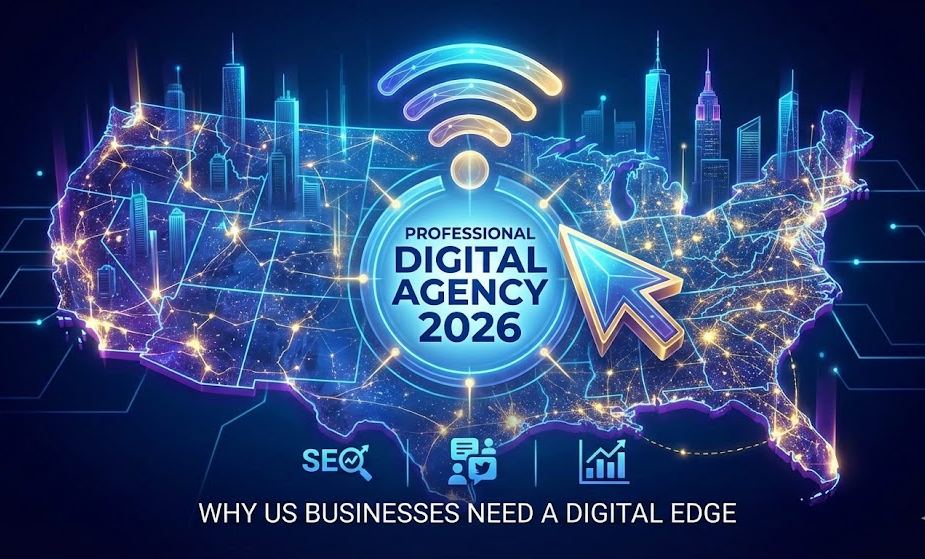
In 2026, the US digital landscape has shifted from simple competition to an AI-driven frontier. With the rise of Generative Engine Optimization (GEO) and the total phase-out of third-party cookies, “DIY” marketing no longer scales. American businesses now face hyper-saturated markets where capturing consumer attention requires sophisticated data integration and multimodal content strategies. Partnering with a professional digital marketing agency is no longer a luxury—it is a strategic necessity. To maintain a competitive edge, brands must leverage expert-led insights to navigate complex algorithms, rising ad costs, and the urgent demand for authentic, human-centric brand storytelling.
Navigating the Era of “Generative Engine Optimization” (GEO)
In 2026, search has shifted from blue links to AI-driven summaries. Navigating Generative Engine Optimization (GEO) is vital for US businesses to remain visible within AI-generated snapshots. By optimizing for citations and topical depth, agencies ensure your brand becomes the trusted source that AI models recommend to high-intent users.
The Evolution from SEO to GEO
In the past, SEO focused on satisfying a list of links; today, GEO focuses on satisfying the large language models (LLMs) that synthesize information for users. As search engines like Google and Bing provide direct, AI-summarized answers, businesses must optimize their content to be “cited” as a credible source within these snapshots. This involves using highly structured data, clear citations, and authoritative claims that AI models can easily parse and present to users as the definitive answer.
Prioritizing Topical Authority Over Keywords
Modern algorithms in 2026 prioritize deep expertise over shallow keyword matching. To succeed in the GEO era, US businesses must build “Topical Authority” by creating comprehensive content clusters that cover every facet of a subject. Instead of targeting a single phrase, you must demonstrate a 360-degree understanding of your niche. This strategy signals to generative engines that your brand is a trustworthy leader, increasing the likelihood that the AI will recommend your services during complex, multi-step user inquiries.
Optimizing for Conversational and Intent-Based Queries
Search behavior has shifted toward long-form, conversational prompts as users “chat” with search engines. GEO requires content that mirrors this natural language. Professional agencies now focus on answering specific, high-intent questions that reflect how people actually speak. By structuring content in a Q&A format and addressing nuanced pain points, businesses can capture “zero-click” opportunities. This ensures that even if a user doesn’t click a link, your brand remains the central authority mentioned in the AI’s generated response.
Mastery of High-Cost, High-Stakes Paid Media
In 2026, rising ad costs make inefficiency fatal. Mastering high-stakes paid media requires moving beyond basic bidding toward AI-driven predictive modeling and creative-led growth. Agencies utilize first-party data and high-velocity content production to ensure every dollar spent targets high-intent users, maximizing ROAS in a crowded, automated, and expensive marketplace.
The Shift from Keyword Bidding to Intent Arbitrage
In the high-stakes environment of 2026, bidding on broad keywords is a recipe for budget exhaustion. Professional agencies have shifted to “Intent Arbitrage,” utilizing AI-driven predictive models to identify users ready to purchase rather than those just browsing. By focusing on bottom-of-funnel queries and conversational intent within AI assistants, agencies ensure that high-cost bids are reserved for the most valuable traffic. This precision prevents the common 20% to 30% budget waste seen in unmanaged accounts, turning expensive ad spend into a calculated investment.
Creative-Led Growth in an Automated Landscape
As ad platforms like Meta and Google take over technical targeting via autonomous “agentic” workflows, the only remaining lever for performance is creative quality. In 2026, “ad fatigue” happens faster than ever, requiring a constant stream of high-impact, short-form video and multimodal assets. Agencies provide the production muscle to scale these creatives while ensuring they remain brand-authentic. They use advanced “creative insights” to determine which hooks resonate, feeding the algorithm high-quality inputs that lower acquisition costs and beat out competitors relying on generic, AI-only outputs.
Navigating the Multi-Channel Attribution Minefield
With the death of third-party cookies, tracking the “customer journey” across Connected TV (CTV), social commerce, and search has become a technical nightmare. US businesses often struggle with misattribution, leading them to cut budgets for the very channels driving their sales. Agencies solve this by implementing first-party data “clean rooms” and sophisticated attribution modeling. They bridge the gap between discovery and checkout—particularly as “shoppable” ads on platforms like TikTok and Instagram become the norm—ensuring every touchpoint is measured and optimized for maximum long-term growth.
First-Party Data & Privacy Compliance
In 2026, data privacy is a competitive necessity. As third-party cookies vanish, US businesses must master First-Party Data to survive. Professional agencies implement secure collection systems and ensure compliance with complex state laws, transforming legal requirements into consumer trust while building a proprietary database that fuels personalized, high-conversion marketing.
Building a Robust First-Party Data Asset
With the total deprecation of third-party tracking, US businesses must collect data directly from their audience via “value exchanges.” This includes using loyalty programs, interactive quizzes, and gated content to gather insights like purchase intent and preferences. Agencies help implement Customer Data Platforms (CDPs) to unify these touchpoints into a single, high-accuracy customer view. By owning this data, you reduce reliance on external platforms, lower acquisition costs, and create a “competitive moat” that generic competitors simply cannot match.
Navigating the Patchwork of US Privacy Laws
In 2026, privacy compliance is a complex legal landscape featuring strict regulations like the CCPA and a growing list of state-level mandates in Oregon, Texas, and beyond. Professional agencies ensure your website utilizes advanced Consent Management Platforms (CMPs) that adapt in real-time to a user’s location. This proactive approach prevents “dark patterns” in UI and shields your business from massive non-compliance fines. More importantly, it transforms legal necessity into a trust-building feature that enhances your brand’s overall reputation.
Privacy-Led Marketing as a Brand Differentiator
Modern US consumers are hyper-aware of their digital footprint and prefer brands that respect their boundaries. Agencies now use Privacy-Led Marketing to turn transparency into a conversion tool. By clearly communicating how data is used and offering granular control over preferences, you foster deeper customer loyalty. This ethical “human-in-the-loop” strategy ensures that personalization feels helpful rather than “creepy,” driving higher engagement rates and establishing a foundation of trust that is essential for long-term customer lifetime value.
Short-Form Video & Multimodal Content Production
In 2026, attention is the most valuable currency. With short-form video driving over 80% of web traffic, US businesses must adopt a multimodal strategy that blends vertical clips, immersive AR, and audio. Agencies provide the creative velocity and technical expertise to turn these snackable moments into high-converting social commerce engines.
Dominating the Vertical Video Revolution
By 2026, platforms like TikTok, YouTube Shorts, and Instagram Reels have become the primary discovery engines for American consumers. To succeed, businesses must produce high-velocity vertical video that feels organic rather than “corporate.” Professional agencies utilize specialized creators and AI-assisted editing suites to churn out relatable, trend-aware content at scale. This constant presence in the feed ensures your brand remains top-of-mind, leveraging the “social commerce” surge where users discover and purchase products within a single sixty-second viewing experience.
Leveraging Multimodal Content for Diverse Audiences
Modern marketing requires more than just one format; it demands a multimodal approach where video, audio, and interactive elements work in harmony. In 2026, consumers expect to transition seamlessly from a short video to a branded podcast or an augmented reality (AR) product preview. Agencies manage this complexity by repurposing core assets into various formats, ensuring a consistent brand voice across all sensory touchpoints. This strategy maximizes reach and accessibility, catering to different learning styles and consumption habits within the diverse US market.
Integrating AI with Human Creative Direction
While generative AI tools can produce video clips in seconds, they often lack the emotional nuance required for true brand loyalty. In 2026, the most successful agencies use a “human-in-the-loop” model, using AI for rapid prototyping and technical transitions while relying on human directors for storytelling and cultural relevance. This hybrid approach allows for high-volume production without sacrificing the authenticity that US audiences crave. It ensures your content doesn’t just fill a slot in the algorithm but actually builds a lasting emotional connection.
Bridging the “AI-Human” Gap
In 2026, automation is common, but trust is rare. Bridging the AI-Human Gap involves using technology for efficiency while ensuring human creativity leads your strategy. Agencies provide the essential “human-in-the-loop” oversight to prevent robotic content fatigue, ensuring your brand remains authentic, empathetic, and deeply connected to your audience.
Infusing Emotional Intelligence into Automated Systems
While AI in 2026 can predict what a customer might buy, it cannot truly understand why they feel a certain way. Professional agencies bridge this gap by injecting emotional intelligence (EQ) into automated workflows. By supervising AI-generated drafts, human editors ensure that brand messaging resonates with empathy, cultural nuance, and humor—elements that algorithms often miss. This “human-in-the-loop” approach prevents the robotic “AI-slop” that triggers consumer fatigue, turning cold data points into meaningful, trust-building stories.
Transitioning from B2B to H2H (Human-to-Human)
In a hyper-automated landscape, the most successful US brands are moving away from rigid B2B frameworks toward an H2H (Human-to-Human) philosophy. Agencies facilitate this by prioritizing community-building and authentic leadership over generic outreach. Instead of letting AI send thousands of identical emails, agencies use AI to identify the perfect moment for a human to step in—whether through a personalized video message or a community event. This ensures that every high-stakes interaction feels personal and genuinely earned.
Guarding Brand Integrity Against AI Hallucinations
As AI models occasionally produce factual errors or “hallucinations,” businesses face significant reputational and legal risks in 2026. A professional agency acts as the ultimate brand guardian, providing rigorous human oversight of all AI outputs. They implement strict auditing processes to verify data accuracy, eliminate algorithmic bias, and ensure that every piece of content aligns with your specific brand voice. This layer of human accountability is essential for maintaining the high E-E-A-T standards required to rank in modern generative search engines.
Comparison: In-House vs. Digital Marketing Agency (2026)
Feature |
In-House Team |
Digital Marketing Agency |
| Tooling Costs | High ($20k+/yr for enterprise AI & SEO tools) | Included in service fees |
| Specialization | Generalist focus | Specialists in GEO, PPC, and Data Science |
| Scalability | Slow (requires hiring/training) | Instant (on-demand resources) |
| Adaptability | Reactive to platform changes | Proactive (early access to beta features) |
Final Thoughts
In 2026, a digital marketing agency is no longer a vendor; they are a system architect. They integrate your web design, search strategy, and lead generation into a single, self-optimizing ecosystem. For US businesses looking to capture a share of the nearly $500 billion domestic digital market, professional expertise is the only way to ensure your marketing budget is an investment, not an expense.