


For non-technical leaders, engineering roadblocks often feel like a black box. You map out a high-level product roadmap, align your stakeholders, and set ambitious deadlines—only to watch projects stall because “Team A is waiting on Team B, who are blocked by a core infrastructure update.”
Engineering dependencies are the invisible friction that slows down delivery, inflates budgets, and drains team morale. You don’t need to write code to untangle them, but you do need a structured framework to manage them.
Here is a practical guide for non-technical leaders on how to map, measure, and mitigate engineering dependencies before they derail your next major initiative.
Map: Uncovering Hidden Engineering Roadblocks
Before you can manage dependencies, you have to make them visible. In many organizations, dependencies live entirely inside the heads of senior engineers or scattered across dense architecture diagrams that non-technical leaders struggle to interpret.
To build a clear picture without getting bogged down in technical jargon, use these approaches:
Host Dependency Mapping Workshops
Bring engineering leads together specifically to trace cross-team workflows before a project begins. Ask simple, high-impact questions: “If we want feature X to launch on Date Y, what systems, teams, or data pipelines must be finished first?” These sessions break down communication silos, align cross-functional teams, and surface hidden roadblocks early. By visualizing dependencies collaboratively, leaders can establish clear accountability and prevent costly delays down the line.
Focus on Inputs and Outputs
Instead of getting bogged down in how a feature is technically built, focus purely on what a team needs to receive before they can start their work, and what they must deliver for others to proceed. Defining clear deliverables removes technical ambiguity. When non-technical leaders anchor conversations around concrete data inputs and functional outputs, they empower teams to communicate clearly without needing a deep understanding of internal code architecture.
Leverage Existing Tooling Visuals
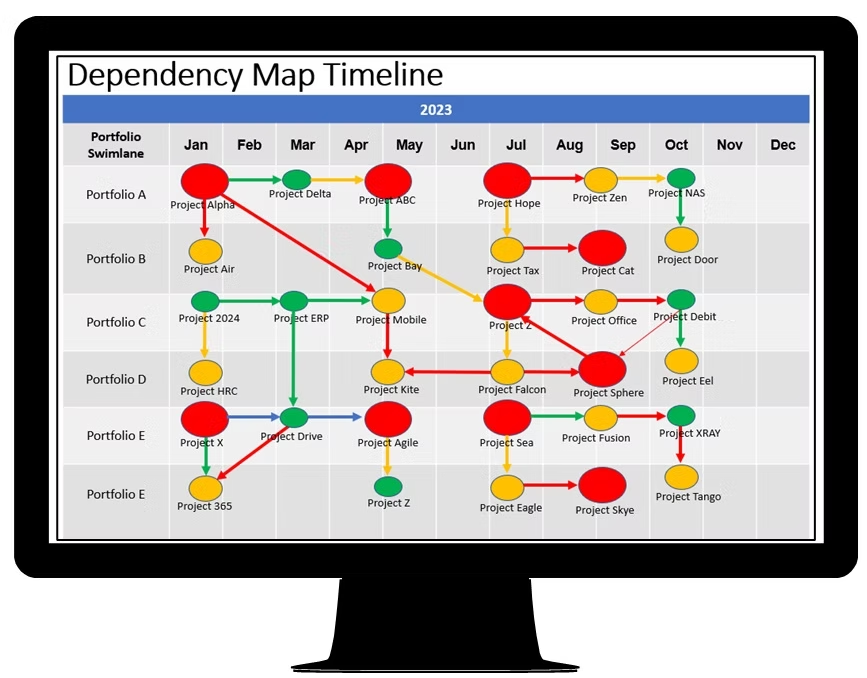
Modern enterprise project management platforms like Jira, Linear, or Aha! feature powerful dependency-mapping plugins and interactive timeline views designed to track blockers in real-time. Ask your engineering managers to flag links and blocking relationships visually. This approach transforms complex, text-heavy status reports into intuitive dashboards. With clear visual mapping, executives can instantly spot chokepoints and make strategic decisions without disrupting ongoing engineering operations or developer focus.
Measure: Quantifying the Impact on Delivery
You cannot improve what you do not measure. Relying on subjective status updates like “we’re almost done” or “it’s blocked by infrastructure” leaves leadership blind to systemic inefficiencies.
To bring objective clarity to your engineering workflows, track these key metrics:
Block Time (Lead Time Lost)
Measure how long a ticket, task, or project sits in a “Blocked” status before resolution. High block times indicate that cross-team dependencies are not being resolved quickly enough, pointing to underlying communication breakdowns or resource shortages. By tracking this specific metric, non-technical leaders can spot workflow friction, hold teams accountable for timely handoffs, and intervene before minor roadblocks cascade into major delivery delays that threaten the entire strategic product release schedule.
Bottleneck Frequency
Track which specific teams, systems, or external vendors appear most frequently as blockers across multiple concurrent projects. If a single platform team or legacy database system acts as a dependency for eighty percent of your roadmap, you have officially identified your primary structural constraint. Recognizing bottleneck frequency allows leaders to reallocate resources, invest in infrastructure upgrades, or hire strategically to remove chronic chokepoints and stabilize overall engineering velocity.
Dependency Ratio
Look closely at the percentage of tasks in a sprint or release cycle that rely entirely on another team versus those that can be completed autonomously. A high dependency ratio signals an overly coupled architecture and fragile planning structures. By monitoring this ratio over time, executives can push engineering leadership toward modular design principles, ensuring teams operate with greater autonomy and face fewer external disruptions during execution.
Mitigate: Actionable Strategies to Keep Projects Moving
Once you have mapped where dependencies live and measured their impact, you can implement proactive strategies to minimize their disruption.
Decouple Teams and Codebases
Where possible, encourage engineering leadership to design systems with modularity in mind. Microservices and decoupled APIs allow different teams to work independently without stepping on each other’s toes or waiting for shared code repositories to update.
Establish Clear SLAs for Cross-Team Requests
When dependencies are unavoidable, formalize the agreement between teams. Establish Service Level Agreements (SLAs) for cross-team requests—such as API documentation delivery or security reviews—so expectations are explicit and accountable.
Apply the Critical Path Method (CPM)
Identify the sequence of dependent tasks that represents the absolute longest path to completion. By focusing your executive oversight solely on the critical path, you avoid micromanaging non-essential tasks while keeping laser-focused on the items that actually dictate your launch date.
Conclusion
Managing engineering dependencies doesn’t require a computer science degree. By treating dependencies as operational risks rather than purely technical hurdles, non-technical leaders can transform unpredictable roadmaps into streamlined, predictable delivery engines. Map the connections, track the friction points, and build structural autonomy to keep your strategic goals moving forward.