
In 2026, the SEO landscape has shifted from “matching keywords” to “earning trust.” With Google’s Search Generative Experience (SGE) and AI Overviews dominating the top of the SERPs, simply ranking #1 isn’t enough—you need to be the source the AI cites.
If you want to maintain visibility in this AI-first world, your strategy must evolve. Here is the definitive SEO ranking checklist for 2026.
Technical Foundation: The “Clarity” Audit
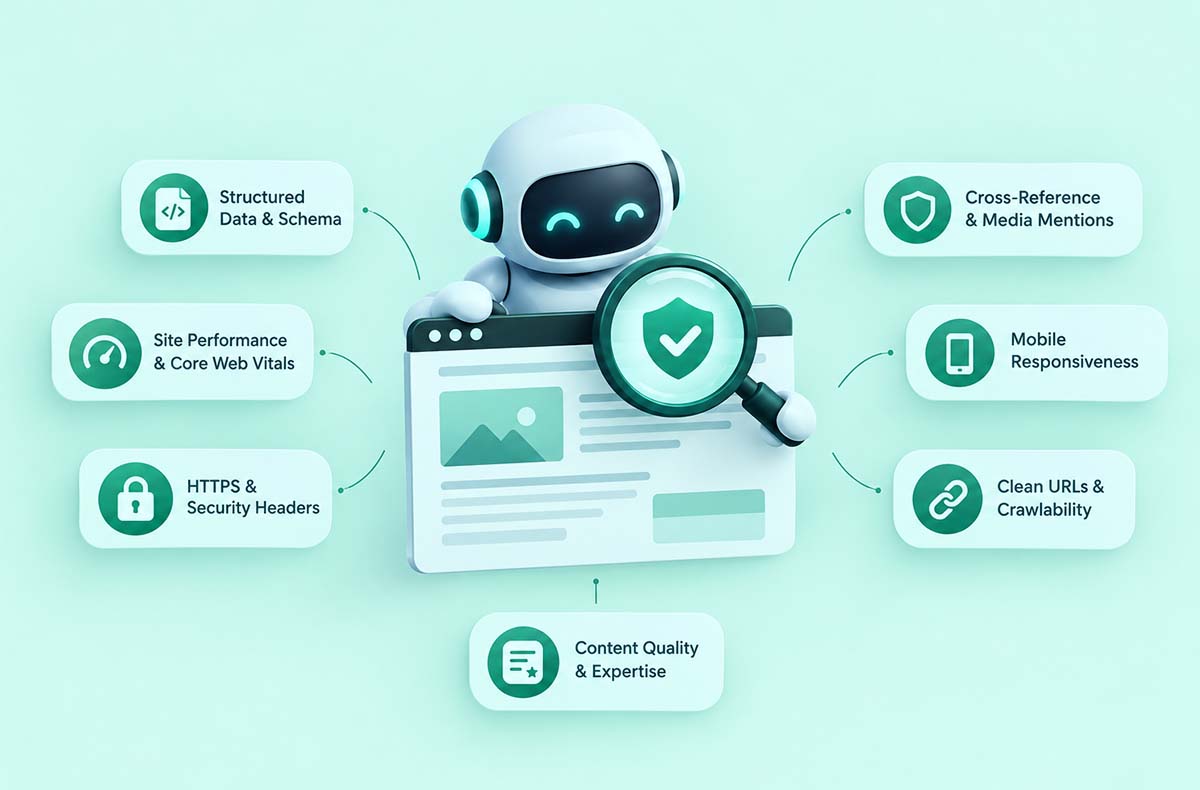
A site’s technical health is the bedrock of 2026 search success. The “Clarity” Audit ensures your infrastructure is transparent to both humans and AI crawlers. Beyond fixing broken links, this audit streamlines your site’s code to remove bloat that confuses search agents. By optimizing your backend for readability, you ensure that search engines can accurately index your unique value and prioritize your content within increasingly competitive AI-generated search results.
Optimize for INP (Interaction to Next Paint)
In 2026, user patience is at an all-time low. INP has surpassed traditional speed metrics, measuring exactly how long it takes for your site to react to a user’s touch or click. To rank, your page must feel instantaneous. Optimizing for INP involves minimizing main-thread work and reducing JavaScript execution, ensuring your interface remains fluid, responsive, and professional.
Implement Advanced Schema Markup
Schema is the language search engines use to understand context. In 2026, basic tags aren’t enough. You must implement advanced JSON-LD for “Speakable” content and “Expert” profiles to feed the Knowledge Graph. Detailed markup helps AI agents identify your content as a verified source, significantly increasing your chances of being cited in voice search results and interactive AI summaries.
Audit for AI Accessibility
With AI Overviews dominating the SERPs, you must ensure your site is “AI-friendly.” This audit involves checking your robots.txt and server headers to ensure bots like Google-Extended or GPTBot aren’t blocked from crawling your key insights. By making your data accessible to these agents, you position your brand to be the primary reference point for complex AI-generated search answers.
Clean URL Architecture
A logical, “flat” URL structure is essential for modern indexing. Avoid messy, dynamic strings or deeply nested folders that bury your content. Instead, use descriptive, keyword-rich paths like [site.com/topic-name](https://site.com/topic-name). Clean URLs help both users and AI agents map your site’s hierarchy quickly, improving crawl efficiency and ensuring your most important pages receive the authority they deserve.
Content Strategy: The “Information Gain” Era
In a world saturated with AI-generated text, search engines now reward “Information Gain”—the inclusion of new, unique insights not found in existing articles. Regurgitating common knowledge is a recipe for invisibility. To rank in 2026, your content must provide proprietary data, contrarian viewpoints, or specialized expertise. By adding value that didn’t exist on the web before your post, you satisfy algorithms designed to prune redundant, low-effort content.
Prioritize First-Hand Experience (E-E-A-T)
Google’s emphasis on “Experience” has never been stronger. To stand out, showcase real-world application through case studies, original photography, and personal storytelling. Generic advice is easily replaced by AI, but authentic human trial-and-error is irreplaceable. Explicitly demonstrating that you have actually used a product or tested a theory builds the deep trust required to secure top-tier rankings and user loyalty.
Target “Answer Engine” Keywords
Search has evolved into a conversational dialogue. Instead of focusing on fragmented keywords, target “Answer Engine” queries—natural language phrases that reflect how people actually speak to AI assistants. By optimizing for complex, multi-step questions, you position your content to be the definitive source for AI Overviews. Focus on the “why” and “how” to capture intent-driven traffic that seeks specific, actionable solutions.
Modular Content Blocks
Modern search algorithms prefer structured, “snackable” data that can be easily parsed for summaries. Organize your articles into modular content blocks using clear H2 and H3 headers, bulleted lists, and concise paragraphs. This structural clarity allows AI agents to extract specific segments of your text to answer user queries directly, drastically increasing your visibility in featured snippets and interactive search modules.
The “Human-Check” Pass
While AI can accelerate the writing process, the “Human-Check” pass is your final defense against mediocrity. A human editor must verify facts, inject brand personality, and ensure the tone resonates emotionally with your audience. This step eliminates “hallucinations” and robotic phrasing, ensuring your content meets the high-quality standards that both search engines and human readers demand in an automated age.
Authority & Brand: Beyond the Backlink
In 2026, search engines prioritize “Entity Authority” over simple link counts. Establishing a brand that exists independently of its backlinks is crucial for long-term visibility. This involves cultivating a digital footprint that proves your legitimacy through community engagement, social proof, and expert recognition. When Google recognizes your brand as a trusted entity, you gain a “reputation moat” that protects your rankings from algorithm shifts and makes your content the preferred choice for AI-driven recommendations.
Build Digital PR Mentions
High-quality backlinks are still valuable, but unlinked brand mentions on authoritative news sites and industry forums are now equally powerful. Digital PR focuses on getting your brand discussed in meaningful contexts. By earning mentions on platforms like Reddit, specialized journals, or major news outlets, you signal to search engines that your brand is a relevant, talked-about authority within your specific niche.
Consistent Entity Branding
To be recognized as a trusted entity, your branding must be uniform across the entire web. Ensure your name, address, phone number (NAP), and expert bios are identical on LinkedIn, industry directories, and your own site. This consistency helps AI models connect the dots, confirming that the “Expert” mentioned on one platform is the same “Authority” publishing content on your domain.
Content Hubs & Pillar Pages
Stop treating blog posts as isolated islands. Use content hubs and pillar pages to create a comprehensive web of information. By linking a high-level pillar page to detailed sub-topics, you demonstrate deep topical authority. This structure makes it easier for search engines to crawl your site and recognize you as the ultimate destination for everything related to your core subject.

User Experience (UX): The Engagement Signals
In the 2026 search ecosystem, technical SEO gets you to the door, but User Experience keeps you inside. Google now interprets “dwell time” and “interaction depth” as the ultimate votes of confidence. If users land on your page and find immediate value, your rankings soar. By focusing on satisfying engagement signals, you prove to algorithms that your site isn’t just a placeholder, but a destination that consistently fulfills user intent.
Eliminate “Search Abandonment”
Search abandonment occurs when a user lands on your page and leaves immediately because the answer isn’t obvious. To prevent this, use the “Inverted Pyramid” style: provide the core answer in the first two paragraphs. By satisfying the user’s query instantly, you reduce bounce rates and signal to search engines that your content is the most efficient solution for that keyword.
Interactive Elements
Static text is no longer enough to hold attention. Integrating interactive elements like ROI calculators, live polls, or dynamic comparison charts encourages users to stay longer and engage deeply with your brand. These interactions generate positive behavioral signals that AI-driven search engines track, rewarding your site for providing a high-utility experience that goes beyond simple, passive reading.
Accessibility First
Accessibility is a core pillar of 2026 SEO. A site that is navigable for everyone—including those using screen readers or voice commands—is inherently easier for search bots to index. By prioritizing high color contrast, alt-text for images, and keyboard-friendly navigation, you expand your reach and satisfy search algorithms that increasingly equate inclusive design with high-quality, authoritative web standards.
2026 SEO Quick-Start Table
Priority |
Action Item |
Goal |
| High | Original Data & Case Studies | Boost Information Gain scores |
| High | INP & Core Web Vitals | Ensure 200ms responsiveness |
| Medium | FAQ & How-To Schema | Capture AI Overview citations |
| Medium | Brand Mentions (Digital PR) | Build Entity Authority |
Final Thought
SEO in 2026 isn’t about “gaming” the system; it’s about being the most helpful, authoritative, and unique resource on the web. Focus on the user, optimize for clarity, and provide value that an AI simply cannot replicate.