

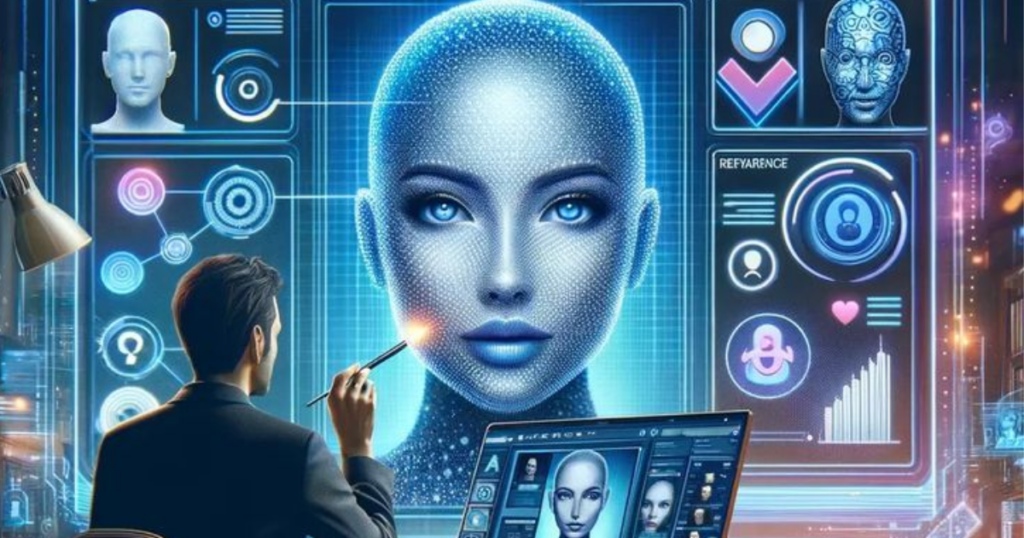
In 2026, generating a hyper-realistic masterpiece is as simple as typing “an astronaut riding a neon horse through a cyberpunk forest.” But beneath the surface of tools like Midjourney, DALL-E 3, and Nano Banana 2, a complex mechanical ballet is taking place.
If you’ve ever wondered how a computer “sees” your words and “paints” a matching picture, you aren’t alone. Here is the step-by-step breakdown of how AI turns text into pixels.
The Translator: Understanding Your Words
Before the AI can draw, it has to understand what you’re asking for. This happens through a process called Text Encoding.
Most modern AI models use a system called CLIP (Contrastive Language-Image Pre-training). Think of CLIP as a bilingual translator that speaks both “Human” and “Image.” During its training, it looked at billions of pictures and their captions, learning that the word “fluffy” matches the visual pattern of a cloud or a kitten.
When you type a prompt, the AI converts your words into a Numerical Vector—a long string of numbers that represents the semantic meaning of your request.
The Canvas: Starting from Chaos (Diffusion)
Contrary to popular belief, the AI doesn’t “copy and paste” from a database of existing photos. Instead, it starts with pure digital static—it looks like the “snow” on an old television set.
The dominant technology today is called a Diffusion Model. The process works in two directions:
Forward Diffusion
Forward Diffusion is the “destructive” phase of training an image AI. Imagine taking a clear photograph and slowly layering digital static over it. Step by step, the model adds Gaussian noise until the original image is completely obliterated, leaving only a chaotic field of random pixels. This process teaches the AI the mathematical relationship between structured data and total entropy.
Reverse Diffusion
Reverse Diffusion is where the creative “magic” happens. Starting with a canvas of pure noise, the AI acts like a digital sculptor. Guided by your text prompt, it predicts and subtracts the noise bit by bit. It iteratively refines the static, slowly pulling recognizable shapes and textures out of the chaos until a coherent, high-resolution image finally emerges.
The Refinement: From Noise to Masterpiece
The AI doesn’t create the image in one go. It performs an Iterative Denoising process.
Imagine looking at a marble block. In the first step, the AI sees a faint shape. In the second, it identifies where the light should be. By step fifty, it has carved out the fine details of the astronaut’s visor or the horse’s mane.
The Technical Workflow at a Glance
Stage |
Component |
What Happens? |
| Input | Text Prompt | You provide the creative direction. |
| Mapping | Latent Space | The AI finds the “mathematical neighborhood” of your idea. |
| Generation | U-Net Predictor | The model predicts which bits of noise to remove. |
| Output | Decoder | The mathematical data is converted into a viewable .jpg or .png. |
Why 2026 is Different: Latent Space and Speed?
Earlier AI models were slow because they tried to calculate every single pixel at once. Today, we use Latent Diffusion.
Instead of working on a giant 1024×1024 image, the AI works in a “compressed” version called Latent Space. It’s like a mathematical shorthand that allows the AI to process the essence of the image much faster. Once the “shorthand” version is perfect, a Decoder blows it back up into a high-resolution image for you to see.
Final Thoughts
Ultimately, AI image generation is a sophisticated dance between linguistic understanding and mathematical reconstruction. By mastering the transition from chaotic noise to structured art through diffusion, these models do more than just “filter” the web—they literally dream up new realities. As the gap between human imagination and digital execution closes, the only limit left is the prompt you write. Ready to start creating your next masterpiece?