
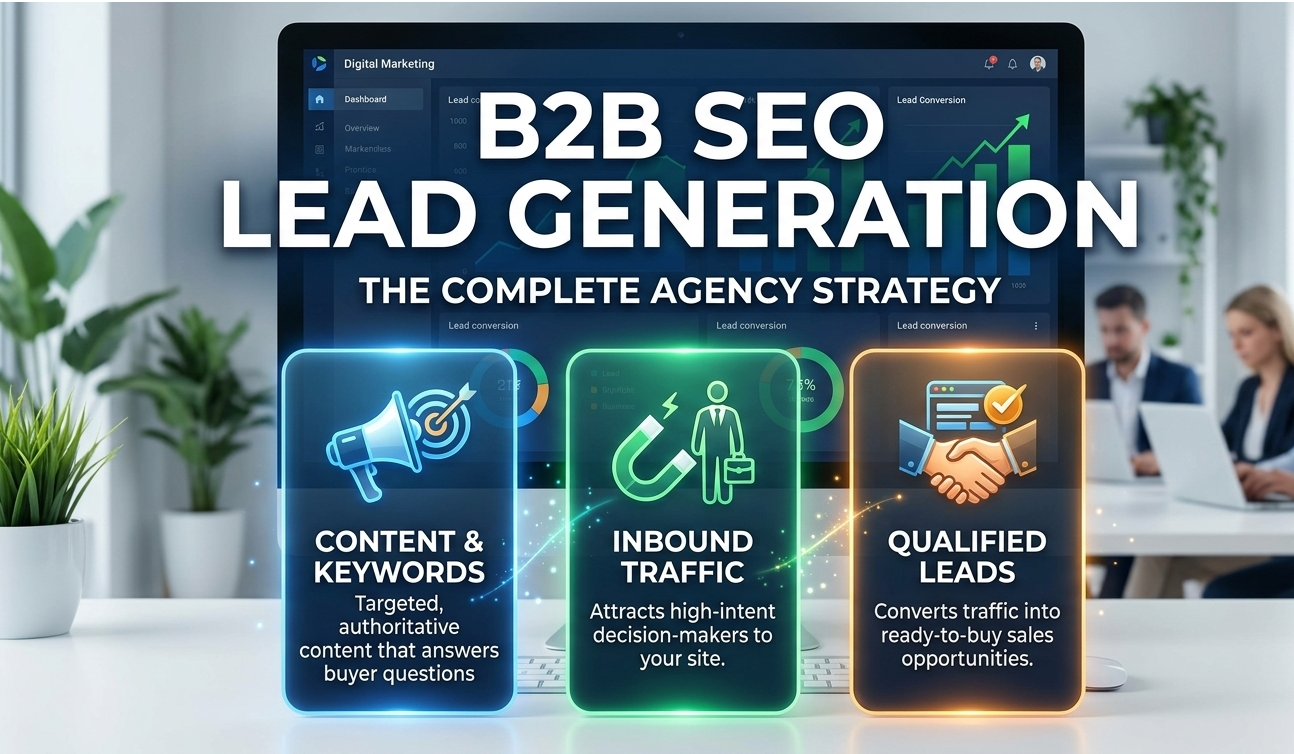
In the B2B world of 2026, the traditional “publish and pray” SEO model is dead. For a B2B SEO marketing agency, the goal has shifted from chasing high-volume vanity metrics to capturing high-intent “decision-stage” traffic. With the rise of AI Overviews (AIOs) and Generative Engine Optimization (GEO), a modern agency must do more than just rank; it must ensure its clients are the cited authorities in the AI-synthesized answers that now dominate 12.5% of informational queries (Evergreen Media, 2026).
Here is the exact framework a top-tier B2B SEO agency uses to generate high-quality leads in the current landscape.
Mapping Content to the “Invisible” Buyer Journey
Unlike B2C, where a purchase can happen in minutes, B2B sales cycles in 2026 often span months and involve multiple stakeholders (Impulse Digital, 2026). An agency generates leads by creating content for every specific person in the decision-making unit:
The End-User
The end-user seeks immediate solutions to daily operational friction. Content targeting this segment must be highly tactical, offering “how-to” guides, troubleshooting tips, and feature-specific walk-throughs. By solving their granular problems through SEO-driven educational assets, an agency builds grassroots brand advocacy. When the time comes for software or service evaluation, the end-user becomes the internal champion for your brand.
The Department Head
Department heads focus on team efficiency, scalability, and hitting quarterly KPIs. They aren’t just looking for tools; they are looking for strategic partnerships that streamline workflows and reduce overhead. Lead-generating content for this group shifts toward high-level “Middle-of-Funnel” assets, such as integration guides and performance benchmarks, proving that your solution can handle the heavy lifting of their specific departmental goals.
The CFO
The CFO is the final gatekeeper, primarily concerned with risk mitigation, cost-benefit analysis, and long-term ROI. Content must speak the language of “Bottom-of-Funnel” logic, utilizing detailed case studies, pricing transparency, and fiscal impact reports. To convert at this level, an agency must leverage data-backed narratives that demonstrate how the investment protects the bottom line while driving sustainable, predictable corporate growth.
Leveraging Generative Engine Optimization (GEO)
In 2026, clicks are becoming rarer as Google’s AI Overviews summarize information directly on the search page. However, the leads that do come through are often higher quality because the AI acts as a “digital consultant,” recommending the brand as a definitive answer (First Launch, 2026). Agencies now optimize for this by:
Building Information Gain
In 2026, Google prioritizes “Information Gain”—the inclusion of original data or unique insights not found in existing search results. A B2B agency generates leads by publishing proprietary research, first-party surveys, and expert interviews. This unique value proposition prevents your content from becoming a commodity, signaling to both AI algorithms and human decision-makers that your brand is a primary knowledge source.
Structured Formatting
To capture “zero-click” visibility, content must be technically digestible for both users and AI crawlers. Agencies use logical H2 and H3 hierarchies, concise bullet points, and “Answer Blocks” optimized for Generative Engine fragments. This structured approach ensures your key value propositions are easily extracted by AI Overviews, positioning your agency as the cited authority at the very top of the SERP.
Prioritizing “Bottom-of-Funnel” (BOFU) Keywords
High search volume is often a trap in B2B. A keyword with only 150 monthly searches, like “best ERP system for mid-market manufacturing,” is infinitely more valuable for lead generation than a general term with 10,000 searches (Impulse Digital, 2026).
Agencies generate quality leads by focusing on:
- Comparison Pages: “Vendor A vs. Vendor B” guides.
- Alternative Pages: “Best [Competitor] Alternatives.”
- Service Pages: Often neglected in favor of blogs, these pages must be robust and optimized for high-intent transactional terms (Impulse Digital, 2026).
Establishing E-E-A-T Through “Social Proof” SEO
Trust is the primary driver of B2B conversions. Modern agencies lean heavily on Google’s E-E-A-T framework (Experience, Expertise, Authoritativeness, Trustworthiness). In 2026, this means integrating real-world proof directly into the SEO strategy:
Case Studies
Case studies act as the ultimate social proof, transforming abstract promises into tangible evidence. By detailing specific client challenges, the strategic intervention applied, and the resulting measurable growth, these assets address the “Bottom-of-Funnel” skepticism inherent in B2B. High-quality leads are often generated when prospects see a mirrored version of their own obstacles successfully overcome through your agency’s proven, data-backed methodology.
User-Generated Content (UGC)
In a professional landscape often crowded by polished corporate speak, UGC offers authentic validation. B2B agencies leverage testimonials, LinkedIn endorsements, and third-party reviews to satisfy Google’s “Experience” criteria. This unfiltered feedback signals reliability to potential leads, bridging the trust gap. When prospects see peers and industry leaders vouching for your results, the perceived risk of engagement drops, accelerating the lead conversion cycle.
Digital PR
Digital PR elevates a brand’s authority beyond its own domain by securing placements in high-tier industry publications. These authoritative mentions and high-quality backlinks serve as powerful trust signals for both search engines and decision-makers. By positioning your agency’s experts as thought leaders in external media, you build a “halo effect” of credibility that attracts high-value leads looking for the market’s most recognized specialists.
Capturing “Zero-Click” Leads
Since many users now get their answers directly from AI summaries, agencies use Gated Content to capture leads who want to go deeper. While Google cannot index content behind a form, agencies use SEO to drive traffic to “teaser” pages that offer high-value whitepapers or proprietary research in exchange for an email address (Impulse Digital, 2026).
Conclusion
Generating quality B2B leads in 2026 requires a shift from keyword volume to authority and intent. By blending technical precision—like GEO and structured formatting—with human-centric trust signals such as case studies and digital PR, agencies capture buyers at every journey stage. Ultimately, the most successful strategies focus on providing unique “Information Gain,” ensuring your brand isn’t just another search result, but the definitive cited answer that decision-makers trust.