
Artificial intelligence is no longer a futuristic concept reserved for tech giants—it is an accessible operational engine for businesses of all sizes. However, when leadership teams decide to integrate AI, they frequently hit a wall of indecision: Where do we start?
Attempting to automate everything at once leads to fragmented systems, employee fatigue, and high implementation costs. The key to a successful digital transformation isn’t adopting the most complex technology; it’s identifying the highest-impact, lowest-friction workflow to automate first.
Here is a strategic blog on how to choose your business’s first AI workflow, why the initial choice dictates long-term success, and the top contenders for your starting point.
Why Your First AI Workflow Matters?
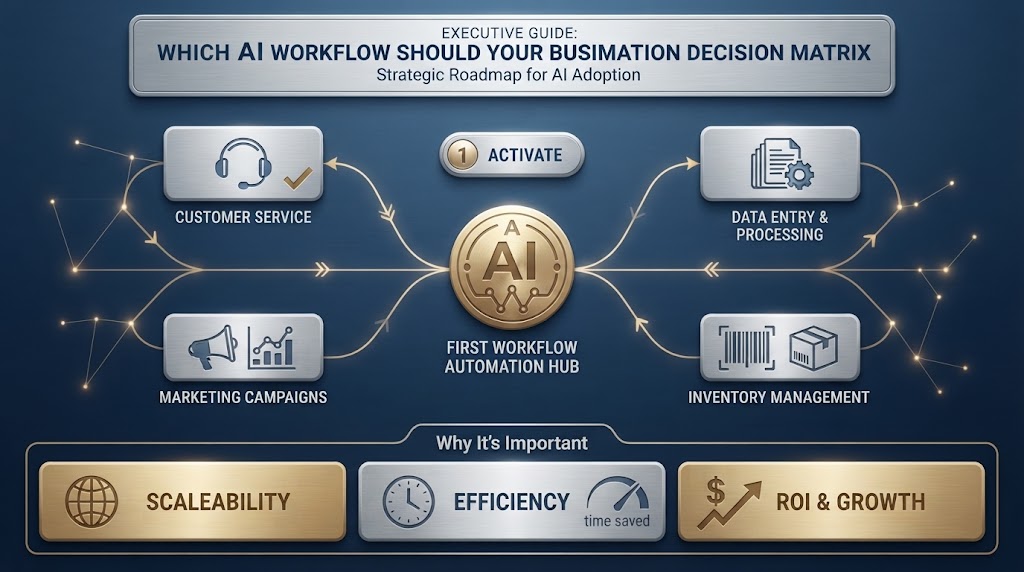
Your initial AI automation project sets the cultural and operational precedent for every subsequent technology rollout. Choosing the right first workflow offers three vital advantages:
Proves ROI Quickly
Stakeholders and financial decision-makers always want to see tangible returns before committing to long-term technology investments. By targeting a high-friction, repetitive task as your initial pilot, you can rapidly track and measure cost savings, hours recovered, and efficiency gains. This immediate, quantifiable success validates your technological expenditure, secures executive buy-in, and provides concrete metrics needed to justify funding future digital transformation initiatives across the organization.
Encourages Team Adoption
Employees are often naturally hesitant about artificial intelligence due to unfounded fears regarding job security and workflow disruption. Overcoming this resistance requires proving that automation serves as an empowering assistant rather than a replacement. When your first automated workflow eliminates tedious, mind-numbing administrative duties—such as data entry or sorting emails—staff members immediately experience a lighter daily workload, fostering organic enthusiasm and long-term technological buy-in.
Builds Internal Expertise
Successful automation relies just as much on human oversight as it does on algorithms. Launching a manageable pilot project gives your internal teams the essential runway required to learn how to monitor model accuracy, refine prompts, and troubleshoot system integrations. This controlled environment ensures your workforce gains critical, hands-on artificial intelligence literacy, allowing your business to navigate complex security protocols and operational bottlenecks safely before scaling automation enterprise-wide.
The Top Contenders: Best Workflows to Automate First
Not all business processes are ready for artificial intelligence. The ideal starting workflows share common traits: they are data-heavy, repetitive, rule-based, and prone to human error.
Here are the three best workflows to consider automating first:
Customer Support Tier-1 Ticketing & FAQ Handling
Customer support teams frequently spend up to seventy percent of their working hours answering repetitive questions regarding order statuses, password resets, and shipping updates. Implementing artificial intelligence for tier-one ticketing allows conversational chatbots and support agents to resolve these routine inquiries instantly, operating twenty-four hours a day. This ensures continuous service availability while significantly lowering operational overhead and customer wait times.
The Workflow
Inbound customer inquiries arrive via chat, email, or web portals regarding basic troubleshooting, account settings, and delivery policies. The artificial intelligence system instantly parses incoming messages, matches them against knowledge base articles, and generates accurate, context-aware responses without requiring human intervention or manual sorting.
Why Automate It First?
Support teams face constant burnout from answering identical queries repeatedly. Automating this layer eliminates repetitive friction instantly. Because tier-one questions rely on standardized, structured data rather than complex emotional intelligence, they serve as the lowest-risk, highest-efficiency entry point for operational artificial intelligence integration.
The Business Impact
Your business experiences a dramatic drop in first-response times and operational support costs. Most importantly, human support agents are freed from mundane tasks to focus on complex, high-empathy customer issues, driving higher customer satisfaction and long-term brand loyalty.
Lead Qualification & CRM Data Entry
Sales velocity entirely depends on speed-to-lead, yet teams waste countless hours manually sorting spreadsheets and inputting contact forms. Implementing artificial intelligence for lead qualification and customer relationship management data entry ensures incoming prospects are instantly analyzed, scored, and organized. This eliminates administrative bottlenecks, prevents high-value leads from slipping through the cracks, and empowers your sales professionals to focus on closing deals.
The Workflow
Inbound web leads submit contact forms or interact with digital assets. The artificial intelligence tool automatically captures prospect data, evaluates it against your ideal customer profile parameters, scores the lead based on behavioral intent, and instantly populates the database while routing qualified prospects to appropriate sales representatives.
Why Automate It First?
Manual data entry is prone to human error and severely slows down response times. Automating this pipeline removes administrative friction immediately. Because lead routing relies on clear, rules-based qualification criteria, it provides a safe, highly measurable starting point for operational automation.
The Business Impact
Your business achieves rapid speed-to-lead metrics, ensuring your sales team engages prospects while interest is peak. Eliminating manual data entry saves hundreds of staff hours annually, reduces administrative overhead, and directly increases overall conversion rates and pipeline revenue.
Invoice Processing & Accounts Payable (AP)
Traditional accounts payable departments struggle with massive volumes of paper and digital invoices, resulting in costly data-entry errors, late payment fees, and heavy administrative overhead. Integrating artificial intelligence transforms this back-office function by streamlining data extraction, verification, and payment scheduling. This automation eliminates manual bottlenecks, catches discrepancies early, and ensures your financial operations run with maximum speed, accuracy, and predictability.
The Workflow
Vendor invoices arrive through emails, portals, or scanned PDFs in various formats. The artificial intelligence system uses optical character recognition and intelligent document processing to extract line items, match them automatically with purchase orders, verify pricing terms, and queue approved bills directly into the financial software.
Why Automate It First?
Invoice processing is entirely rules-based, repetitive, and document-heavy, making it a prime candidate for automation. Manual entry drains accounting hours and invites costly errors. Automating this workflow provides an immediate, frictionless entry point with clear, measurable financial returns from day one.
The Business Impact
Your business drastically reduces processing costs and eliminates late fees while capturing valuable early-payment discounts. Automated matching significantly minimizes fraud risks and human errors, while freeing up your finance professionals to focus on strategic budgeting and financial analysis rather than manual data entry.
4-Step Framework for Choosing Your Specific Starting Point
If you are still deciding between multiple departments, use this four-step evaluation matrix to pinpoint your priority workflow:
Calculate the Volume vs. Value Ratio
When choosing your first workflow to automate, evaluate the direct relationship between employee hours consumed and the task’s strategic importance. Prioritize operational processes that demand massive weekly repetition but deliver low creative value, such as copy-pasting data or sorting routine emails. Avoid automating tasks requiring high emotional intelligence or complex strategic problem-solving. Maximizing this ratio ensures artificial intelligence immediately eliminates peak administrative friction.
Evaluate Data Readiness
Artificial intelligence models require clean, well-structured historical information to function accurately and deliver reliable results. Before committing to an automation project, thoroughly audit whether your business maintains organized spreadsheets, centralized databases, or accessible cloud software. Pick a starting workflow where necessary information is already digitized and standardized. Launching an automation initiative without foundational data readiness will lead to frequent system errors and inaccurate outputs.
Assess Change Management Friction
Technology implementation succeeds or fails based on human adoption rates. Choose a department or operational team that displays genuine openness to digital experimentation and tool optimization. Minimizing internal resistance guarantees smoother onboarding and higher long-term engagement. Avoid starting with teams entrenched in rigid legacy processes, as overcoming cultural barriers during an initial pilot can derail momentum before your artificial intelligence initiative ever scales enterprise-wide.
Measure Integration Complexity
Your first automated workflow should integrate smoothly with your existing software stack, such as your customer relationship management platform, enterprise resource planning system, or helpdesk software. Prioritize solutions that utilize robust native application programming interfaces rather than requiring custom-built, multi-month engineering overhauls. Choosing low-complexity integrations ensures your technical team can deploy, test, and monitor the new automation safely without disrupting daily business operations.
Final Thoughts
The golden rule of enterprise AI adoption is simple: Start small to scale fast.
Don’t try to overhaul your entire operational architecture on day one. Pick one high-friction, repetitive workflow—whether it’s frontline customer support or lead routing—implement an intuitive AI solution, measure the time and cost savings, and use those wins to fund and fuel your next automation wave.